GHF-E090-N03 — 16 April 1974: “‘Open day’ to save ancient Welsh house” (Daily Telegraph)
Wiki catalogue reference: GHF-E090-N03 · Custodian / source URL: Buckler family evidence repository
Evidence preview
1. The evidence
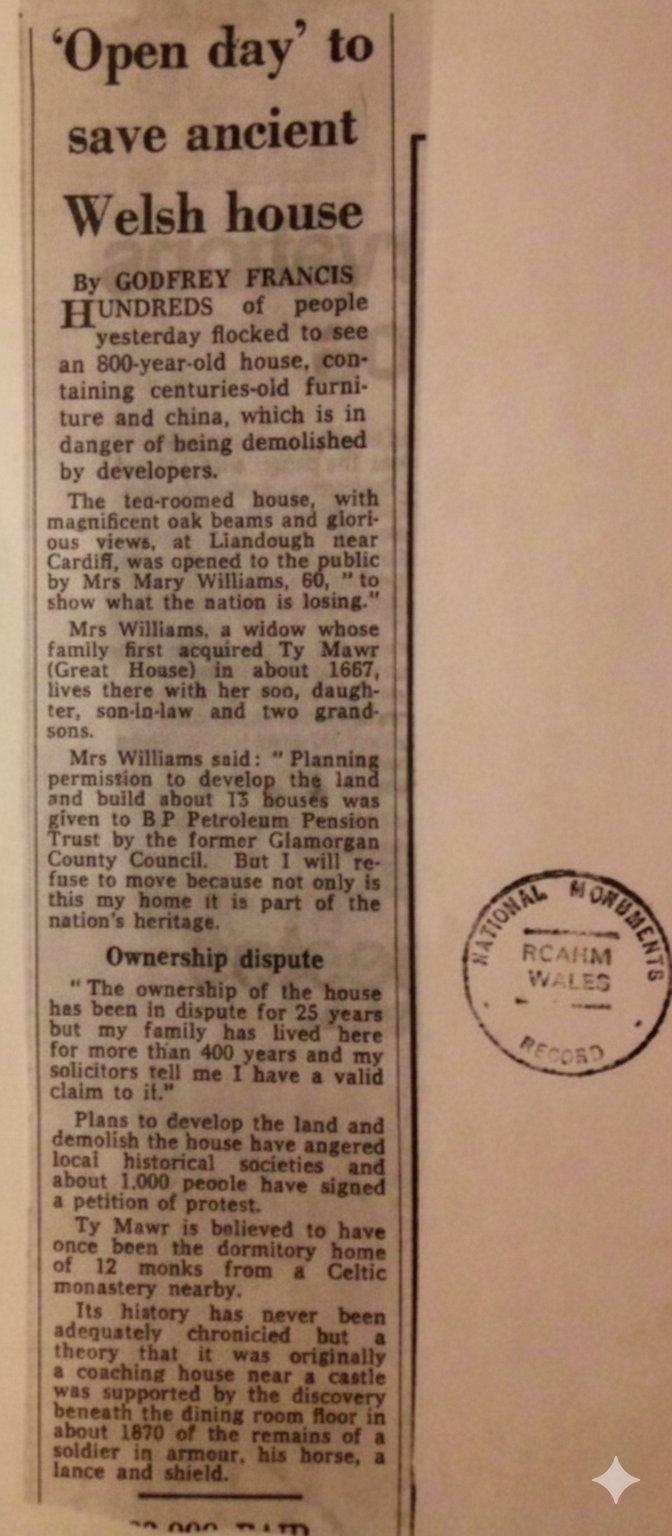

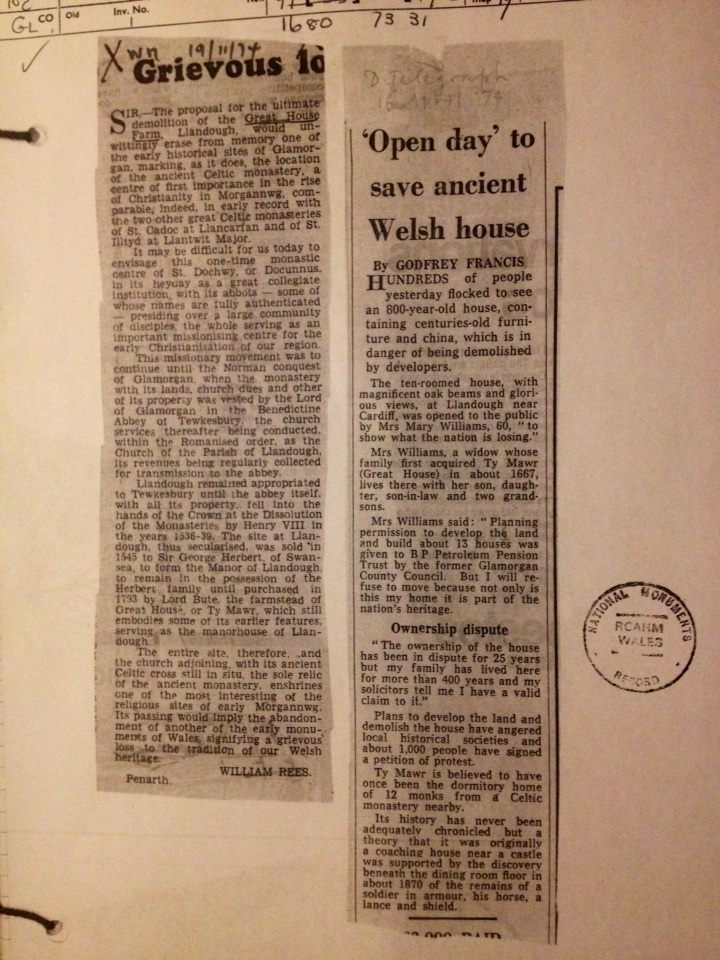

Catalogue UID: GHF-E090-N03 · Custodian/source copy: open source object. Preview and provenance status as at 10-10-2026.
Description
Catalogue: GHF-E090-N03 · Date: 16 April 1974 · Publication: The Daily Telegraph (from the handwritten annotation “D. Telegraph 16 April 74”) · By: Godfrey Francis · Press Archive index
This page follows the wiki’s evidence standard: 1. the evidence (the image), 2. a verbatim transcript, 3. a description of what the item is, and 4. an interpretation of what it shows. Sections 1–3 are meant to be checkable by anyone against the image. Section 4 is open to challenge; corrections are logged under the change-control rule.
DESCRIPTION A national newspaper report of a public open day held at Great House Farm by Mary Williams. It survives as two images: a single cutting, and a scrapbook page on which it is pasted beside William Rees’s letter (GHF-E090-N04). The page carries a Royal Commission (RCAHMW) National Monuments Record stamp, so a copy is also in the national record (compare NMR 6048944).
Date basis: the annotation “D. Telegraph 16 April 74”; Mary’s stated age, 60, fits 1974; and RCAHMW catalogues a Daily Telegraph article of 16 April 1974. The open day itself was the day before, 15 April 1974. The end of the cutting is cut off at a cross-heading beginning “…3,000 PAID”.
Images: Drive 1546141_10201438100374529…jpg; repository 2026-02-16_consortium-newspaper and 2026-02-04_consortium-evidence_002. This item was previously catalogued on this wiki as GHF-E090-A67 and misdated 19 November 1977.
Transcription
Open transcription
Transcribed exactly from the image above, including the original spelling and errors. Square brackets mark editorial notes, cross-headings and captions. […] or … marks text that is cut off or illegible.
HUNDREDS of people yesterday flocked to see an 800-year-old house, containing centuries-old furniture and china, which is in danger of being demolished by developers. The ten-roomed house, with magnificent oak beams and glorious views, at Llandough near Cardiff, was opened to the public by Mrs Mary Williams, 60, “to show what the nation is losing.” Mrs Williams, a widow whose family first acquired Ty Mawr (Great House) in about 1667, lives there with her son, daughter, son-in-law and two grandsons. Mrs Williams said: “Planning permission to develop the land and build about 13 houses was given to B P Petroleum Pension Trust by the former Glamorgan County Council. But I will refuse to move because not only is this my home it is part of the nation’s heritage.”
[Ownership dispute] “The ownership of the house has been in dispute for 25 years but my family has lived here for more than 400 years and my solicitors tell me I have a valid claim to it.” Plans to develop the land and demolish the house have angered local historical societies and about 1,000 people have signed a petition of protest. Ty Mawr is believed to have once been the dormitory home of 12 monks from a Celtic monastery nearby. Its history has never been adequately chronicled but a theory that it was originally a coaching house near a castle was supported by the discovery beneath the dining room floor in about 1870 of the remains of a soldier in armour, his horse, a lance and shield. [The cutting ends; a cross-heading beginning “…3,000 PAID” is cut off.]
Interpretation and wider context
INTERPRETATION The report records Mary publicly claiming ownership in April 1974, more than two months before she pleaded ownership in court on 3 July 1974 and six months before BP’s licence letters of 31 October 1974. It is evidence of what she asserted openly at the time, which bears on the question whether she occupied as an owner-claimant or as a licensee; it is not proof that her claim was right. 🕒
Its details fit other records: the planning permission for about 13 houses given by the former Glamorgan County Council matches the 25 July 1972 permission (the county council was abolished on 1 April 1974); and a dispute of “25 years” dates it to about 1949, when John Williams’s tenancy ended and Frederick Buckler’s began.
Some statements are reported tradition, not established fact: that the house was 800 years old, a dormitory for 12 monks, and that a soldier in armour was found under the dining room about 1870. The museum record for an armour find points to Church Farm, 1858 (see Archaeology, and the Museum’s own records: the 1931 provenance letter, GHF-E106-R33-A1, and the object records for the spur and spearhead, A2 and A3). “First acquired … in about 1667” is Mary’s own account. 🕒
- The 1974 Licence Letters (GHF-E024-03)
- The Restoration Campaign
- Master Timeline (15 April 1974)
- Mary Williams
- Archaeology
← 1897 — “Wireless Telegraphy. Marconi Invention Tested at Lavernock” · Index of press items · 19 November 197? — “Grievous loss” (Western Mail, letter from William Rees) →
Interpretive assessment date: 10-10-2026.