GHF-E090-N02 — 1897: “Wireless Telegraphy. Marconi Invention Tested at Lavernock”
Wiki catalogue reference: GHF-E090-N02 · Custodian / source URL: Buckler family evidence repository
Evidence preview
1. The evidence

Catalogue UID: GHF-E090-N02 · Custodian/source copy: open source object. Preview and provenance status as at 10-10-2026.
Description
Catalogue: GHF-E090-N02 · Date: May 1897 · Publication: Unidentified Cardiff newspaper · Press Archive index
This page follows the wiki’s evidence standard: 1. the evidence (the image), 2. a verbatim transcript, 3. a description of what the item is, and 4. an interpretation of what it shows. Sections 1–3 are meant to be checkable by anyone against the image. Section 4 is open to challenge; corrections are logged under the change-control rule.
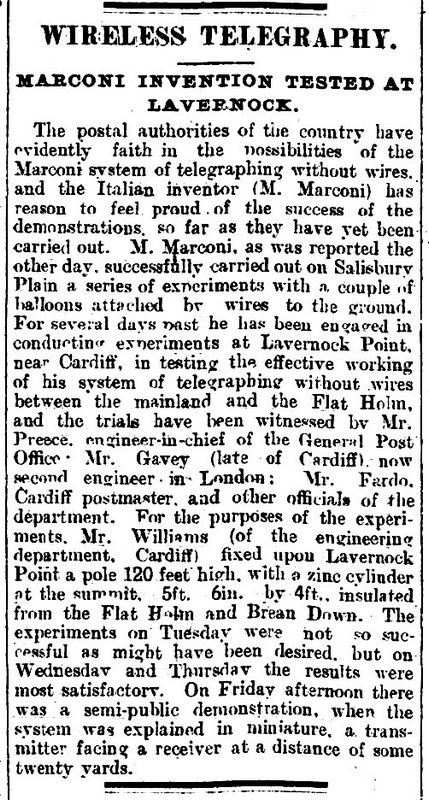
DESCRIPTION A news column on Guglielmo Marconi’s wireless trials between Lavernock Point and Flat Holm in May 1897. The newspaper title and exact date are not on the clipping; the trials are well documented as taking place in May 1897.
Image held in the family’s web archive (file 2026-02-07_consortium-formal_notice_bpvsbuckler__en_v0-0-1_003.jpg). Fully legible.
Transcription
Open transcription
Transcribed exactly from the image above, including the original spelling and errors. Square brackets mark editorial notes, cross-headings and captions. […] or … marks text that is cut off or illegible.
The postal authorities of the country have evidently faith in the possibilities of the Marconi system of telegraphing without wires, and the Italian inventor (M. Marconi) has reason to feel proud of the success of the demonstrations, so far as they have yet been carried out. M. Marconi, as was reported the other day, successfully carried out on Salisbury Plain a series of experiments with a couple of balloons attached by wires to the ground. For several days past he has been engaged in conducting experiments at Lavernock Point, near Cardiff, in testing the effective working of his system of telegraphing without wires between the mainland and the Flat Holm, and the trials have been witnessed by Mr. Preece, engineer-in-chief of the General Post Office; Mr. Gavey (late of Cardiff), now second engineer in London; Mr. Fardo, Cardiff postmaster, and other officials of the department. For the purposes of the experiments, Mr. Williams (of the engineering department, Cardiff) fixed upon Lavernock Point a pole 120 feet high, with a zinc cylinder at the summit, 5ft. 6in. by 4ft., insulated from the Flat Holm and Brean Down. The experiments on Tuesday were not so successful as might have been desired, but on Wednesday and Thursday the results were most satisfactory. On Friday afternoon there was a semi-public demonstration, when the system was explained in miniature, a transmitter facing a receiver at a distance of some twenty yards.
Interpretation and wider context
INTERPRETATION The article confirms the trials at Lavernock Point, about 4 km south of Llandough, and that “Mr. Williams (of the engineering department, Cardiff)” erected the 120-foot pole. That Mr Williams is described as a Post Office engineer.
The article does not mention Great House Farm or the Williams family of the farm. The family’s account that Marconi stayed at the farm, and that a Williams of the farm helped him, is neither confirmed nor contradicted by this report. Linking the engineer to the farm family would need a separate source, such as a Post Office staff record or census entry. 🕒
← 1891 — “Llandough. Alleged Farmyard Theft” · Index of press items · 16 April 1974 — “‘Open day’ to save ancient Welsh house” (Daily Telegraph) →
Interpretive assessment date: 10-10-2026.