GHF-E090-N04 — “Grievous loss” (Western Mail, letter from William Rees, 19 November 1974 or 1977)
Wiki catalogue reference: GHF-E090-N04 · Custodian / source URL: Buckler family evidence repository
Evidence preview
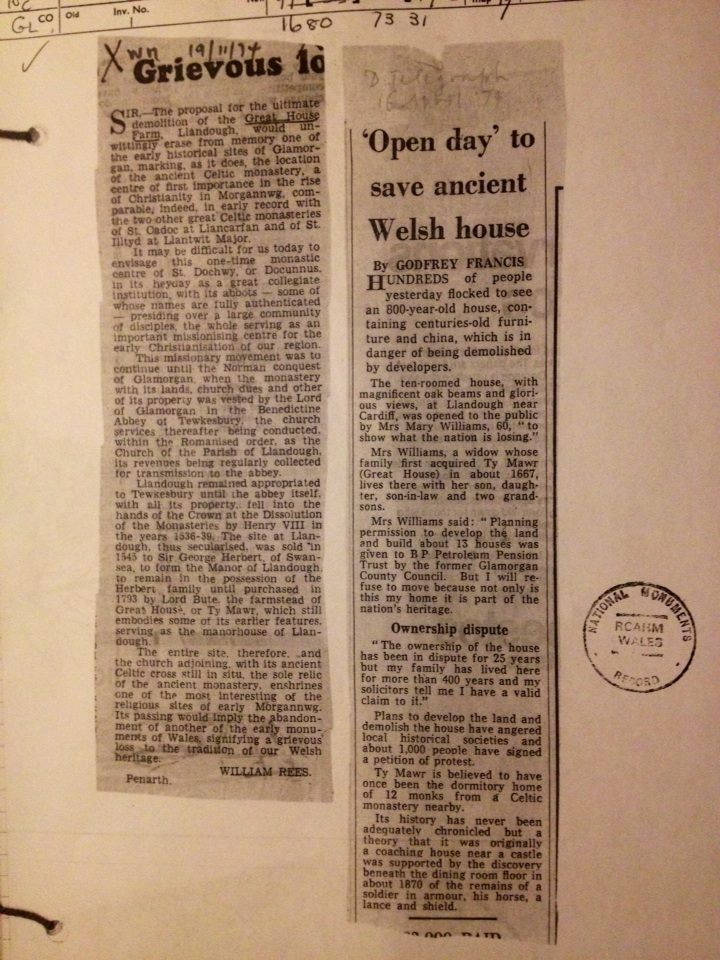
Catalogue UID: GHF-E090-N04 · Custodian/source copy: open source object. Preview and provenance status as at 10-10-2026.
Description
4. Provenance and where to check it
DOCUMENTED (press report — reader’s letter). Catalogue no. GHF-E090-N04. Sections 1 to 4 record what the cutting is and says. Section 5 is the Wiki’s reading and is open to challenge. A letter records its writer’s opinion and a published secondary account of history, not a primary record. Jump to: Evidence · Transcript · Description · Provenance · Interpretation.
- What it is: a reader’s letter in the Western Mail, signed William Rees, Penarth, headed “Grievous loss”.
- Publication and date: the hand annotation reads “WM 19/11/7?”. The final digit of the year is unclear.
- What it argues: that demolishing the farm would erase an early historical site of Glamorgan, the site of the Celtic monastery of St Dochwy (Docunnus), comparable with Llancarfan and Llantwit Major.
- History it asserts, in order: the monastery’s lands vested at the Norman conquest in Tewkesbury Abbey; Llandough appropriated to Tewkesbury until the Dissolution of 1536–39; sale in 1545 to Sir George Herbert of Swansea to form the Manor of Llandough; Herbert family possession until purchase by Lord Bute in 1793; Great House, or Ty Mawr, described as serving as the manor house.
- Source cited by the writer: none.
- Image file:
2026-02-16_consortium-newspaper_bpvsbuckler__en_v0-0-1.jpgin the datro repository. Transcribed on the Press Archive page (N04). - Where to look for the original: the Western Mail of 19 November 1974 or 1977. No archive link has been verified for this title, so none is given. The Findmypast list of Welsh newspaper titles can be checked for whether and for which years the Western Mail is held. Finding the correct year is an open task.
Transcription
Open transcription
2. Verbatim transcript
SIR,—The proposal for the ultimate demolition of the Great House Farm, Llandough, would unwittingly erase from memory one of the early historical sites of Glamorgan, marking, as it does, the location of the ancient Celtic monastery, a centre of first importance in the rise of Christianity in Morgannwg, comparable, indeed, in early record with the two other great Celtic monasteries of St. Cadoc at Llancarfan and of St. Illtyd at Llantwit Major. It may be difficult for us today to envisage this one-time monastic centre of St. Dochwy, or Docunnus, in its heyday as a great collegiate institution, with its abbots — some of whose names are fully authenticated — presiding over a large community of disciples, the whole serving as an important missionising centre for the early Christianisation of our region.
This missionary movement was to continue until the Norman conquest of Glamorgan, when the monastery with its lands, church dues and other of its property was vested by the Lord of Glamorgan in the Benedictine Abbey of Tewkesbury, the church services thereafter being conducted, within the Romanised order, as the Church of the Parish of Llandough, its revenues being regularly collected for transmission to the abbey. Llandough remained appropriated to Tewkesbury until the abbey itself, with all its property, fell into the hands of the Crown at the Dissolution of the Monasteries by Henry VIII in the years 1536-39. The site at Llandough, thus secularised, was sold in 1545 to Sir George Herbert, of Swansea, to form the Manor of Llandough, to remain in the possession of the Herbert family until purchased in 1793 by Lord Bute, the farmstead of Great House, or Ty Mawr, which still embodies some of its earlier features, serving as the manorhouse of Llandough. The entire site, therefore, and the church adjoining, with its ancient Celtic cross still in situ, the sole relic of the ancient monastery, enshrines one of the most interesting of the religious sites of early Morgannwg. Its passing would imply the abandonment of another of the early monuments of Wales, signifying a grievous loss to the tradition of our Welsh heritage. WILLIAM REES. Penarth.
Interpretation and wider context
UNRESOLVED (year) / secondary account (history). Year. Both 1974 and 1977 are possible. The April 1974 open-day report already refers to development plans and a demolition threat, so a letter on the “proposal for the ultimate demolition” in November 1974 would fit. That is a plausibility argument and not proof. The year stays open until a dated page is found. 🕒
What it adds. It shows that the monastic and manorial claims about the site were already being published by a local writer while the house was threatened. It is a published secondary account, not a primary record, and it cites no source. Its statements about the manorial chain before Bute are therefore held as a line of enquiry on the Research Leads page until a primary source is found. They are not treated as established.
What this does not show. It says nothing about the ownership dispute or the Williams family’s title. 🕒
- Establish the year and obtain a dated Western Mail page.
- Trace the 1545 and 1793 transfers to primary sources.
Related: Press Articles Index · Press Archive transcripts · The Bute Estate · Archaeology and Heritage · Evidence Library.
Interpretive assessment date: 10-10-2026.